Postdoctoral Research Fellow
School of Mathematics, University of Birmingham
Research areas
Geometric graphs, biomedical imaging, weak supervision, spectral methods, detection limits, reproducible scientific computing.
Contact
b.cardoen@bham.ac.uk
Spectral-geometric methods for biological discovery under limited observability
I develop mathematical and computational methods for inference, reconstruction, and identifiability in noisy geometric data. My work combines graph signal processing, spectral analysis, topology, and uncertainty-aware algorithms to study biological systems where interaction and function cannot be directly observed.
The common thread is inference under limited observability: when biological structure is only partially measured, I ask what can still be recovered, how stable the recovery is, and what uncertainty should remain.
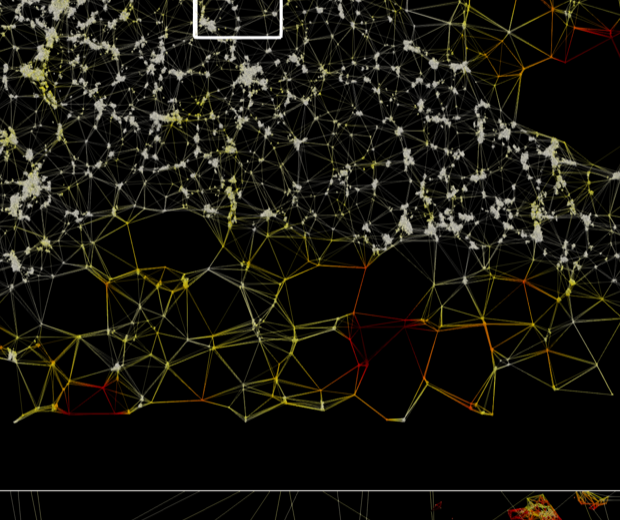
Interaction graph between two SMLM point-cloud datasets.
Research Profile
- Inference limits: identifiability, observability, detectability, and uncertainty bounds.
- Stable reconstruction: spectral methods, graph signal processing, topology, and geometric graphs.
- Measurement-limited discovery: biological imaging and spatial data where direct observation is incomplete.
Limits
Stability
Discovery
Recent and Selected Publications
Modelling temporal dynamics of suicidal ideation and behaviour across pre- to early adolescence using a Markov framework
An interpretable time-inhomogeneous Markov framework for estimating escalation, remission, persistence, and uncertainty in longitudinal suicidal ideation, suicidal behaviour, and non-suicidal self-injury trajectories from ages 9–13.

ROSA: Metric Amplification on Noisy Graphs with Theoretical Guarantees for Amplified Spectral Distances
An order-aware spectral distance-amplification method for detecting weak, localized graph changes under noise, with explicit sufficient conditions for amplification and stability improvements.

Heavy-tailed noise in geometric graphs
Spectral effects of vertex noise in geometric graphs, with implications for when structure can be recovered from noisy spatial measurements.

Computational reconstruction in super-resolution microscopy
A common mathematical framework for comparing computational interaction-analysis methods in multichannel super-resolution microscopy, embedded in a review of methods, validation limits, and the multichannel gap.

Subprecision interaction detection
An algorithmic approach that made nanoscale organelle contact structure measurable in 3D microscopy data.

Full publication record: ORCID
Teaching
Signal Processing for Biological Graphs
I designed and delivered a de novo ten-lecture component for fourth-year Topics in Applied Mathematics at the University of Birmingham. The unit used biological graph data as a route into graph induction, graph spectra, noise effects, spectral clustering, and spectral filtering.
Vision: build conceptual understanding and mathematical judgement under uncertainty, so students can transfer methods to new problems rather than follow recipes.
Execution: created lectures, continuous assignments, and an exam for a research-led applied mathematics topic.
Evidence: archived the course materials and the AI-assisted teaching workflow used to make them reproducible and auditable.
Evaluation: across the ten evaluated items, student responses averaged 23% Agree and 77% Strongly agree (13/24 responses), with strongest scores for intellectual challenge, critical thinking, applied learning, academic support, and contribution to knowledge and skills.
Lecture materials: Signal Processing for Biological Graphs 
Presentation: Improving Accuracy and Reproducibility in Research-Topic STEM Lectures 
Supervision And Mentoring
I currently co-supervise two PhD projects, each at 40% supervision allocation: one on fractal geometry, and one on hormetic systems modelling. I have also supervised or assessed MSc, MSci, and undergraduate projects across graph-based inference, microscopy analysis, and reproducible scientific computing.
My mentoring focuses on decision-making under uncertainty: helping students distinguish what is supported by evidence from what is merely plausible, choose models whose assumptions match the data-generating process, and communicate conclusions with appropriate uncertainty.
Presentations
Improving Accuracy and Reproducibility in Research-Topic STEM Lectures
IDAI presentation on agentic paths for auditable, reproducible lecture production.
Agentic Coding for STEM Research
COSIMO-IDAI tutorial on agentic coding workflows for research.
